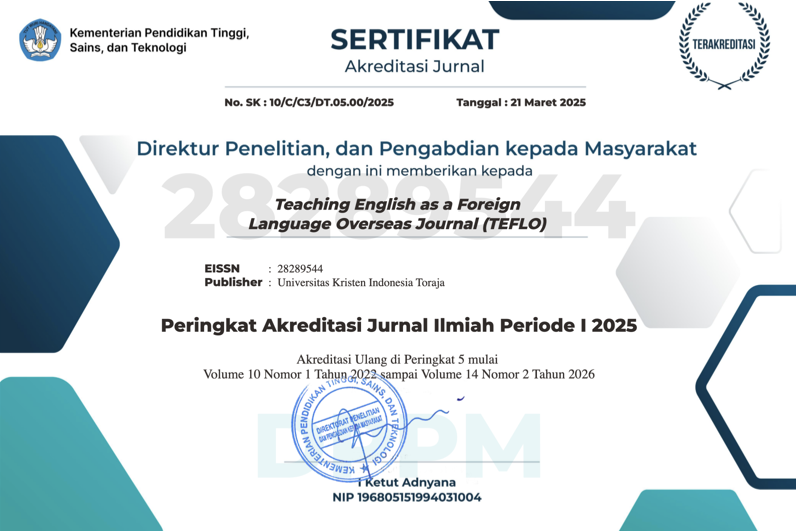
THE ROLE OF GENERATIVE AI IN TEACHING ENGLISH AS A FOREIGN LANGUAGE: OPPORTUNITIES AND PEDAGOGICAL CHALLENGES
DOI:
https://doi.org/10.47178/qamx0b91Keywords:
Generative AI, EFL, Language Learning, Pedagogy, Digital EducationAbstract
The rapid advancement of generative artificial intelligence (GenAI) has significantly transformed educational practices, particularly in English as a Foreign Language (EFL) contexts. This study investigates the role of GenAI in enhancing teaching and learning processes while identifying its pedagogical opportunities and challenges. A mixed-method approach was employed involving 60 eleventh-grade students and two English teachers at a senior high school in Makassar, Indonesia. Data were collected through questionnaires, classroom observations, and interviews. The quantitative findings revealed that 83% of students reported increased engagement when using AI tools, while 78% perceived improvements in their writing skills. Additionally, 72% of students indicated that AI provided helpful personalized feedback. However, 65% admitted relying heavily on AI when completing assignments. Qualitative findings highlighted both benefits and concerns, including increased motivation, improved language exposure, and issues related to accuracy, over-reliance, and teacher readiness. The study concludes that while GenAI offers substantial potential to enhance EFL learning, its effectiveness depends on pedagogically informed implementation and teacher competence. A balanced integration of AI and traditional teaching strategies is recommended to maximize learning outcomes while minimizing risks.
References
Cotton, D. R. E., Cotton, P. A., & Shipway, J. R. (2023). Chatting and cheating: Ensuring academic integrity in the era of ChatGPT. Innovations in Education and Teaching International, 61(2), 228–239. https://doi.org/10.1080/14703297.2023.2190148
Denny, P., Becker, B. A., Luxton-Reilly, A., & Finnie-Ansley, J. (2024). Generative artificial intelligence for education: Opportunities and challenges. Communications of the ACM, 67(4), 56–63. https://doi.org/10.1145/3633174
Feuerriegel, S., Hartmann, J., Janiesch, C., & Zschech, P. (2023). Generative AI. Business & Information Systems Engineering, 66(1), 111–126. https://doi.org/10.1007/s12599-023-00834-7
Godwin-Jones, R. (2017). Emerging technologies: Smartphones and language learning. Language Learning & Technology, 21(2), 3–17.
Holmes, W., Bialik, M., & Fadel, C. (2022). Artificial intelligence in education: Promises and implications for teaching and learning. OECD Publishing. https://doi.org/10.1787/eedfee77-en
Kasneci, E., Seßler, K., Küchemann, S., Bannert, M., Dementieva, D., Fischer, F., Gasser, U., Groh, G., Günnemann, S., Hüllermeier, E., Krusche, S., Kutyniok, G., Michaeli, T., Nerdel, C., Pfeffer, J., Poquet, O., Sailer, M., Schmidt, A., Seidel, T., & Kasneci, G. (2023). ChatGPT for good? On opportunities and challenges of large language models for education. Nature Human Behaviour, 7, 1219–1225. https://doi.org/10.1038/s41562-023-01580-3
Kukulska-Hulme, A. (2020). Mobile-assisted language learning. In C. A. Chapelle (Ed.), The concise encyclopedia of applied linguistics (pp. 1–7). Wiley-Blackwell. https://doi.org/10.1002/9781405198431.wbeal0768
Li, Y., Wang, S., & Han, J. (2023). Artificial intelligence-assisted writing in English language learning: A systematic review. Education and Information Technologies, 28, 15023–15049. https://doi.org/10.1007/s10639-023-11779-7
Luckin, R., Holmes, W., Griffiths, M., & Forcier, L. B. (2018). Intelligence unleashed: An argument for AI in education. Pearson Education.
Redecker, C. (2017). European framework for the digital competence of educators: DigCompEdu. Publications Office of the European Union. https://doi.org/10.2760/159770
Reinders, H., & Benson, P. (2017). Research agenda: Language learning beyond the classroom. Language Teaching, 50(4), 561–578. https://doi.org/10.1017/S0261444817000192
Selwyn, N. (2019). Should robots replace teachers? AI and the future of education. Polity Press.
Yeh, H. C. (2024). Artificial intelligence chatbots and English language learning: Opportunities and challenges. Interactive Learning Environments. Advance online publication. https://doi.org/10.1080/10494820.2024.2307425
Zawacki-Richter, O., Marín, V. I., Bond, M., & Gouverneur, F. (2019). Systematic review of research on artificial intelligence applications in higher education: Where are the educators? International Journal of Educational Technology in Higher Education, 16(39). https://doi.org/10.1186/s41239-019-0171-0
Zhai, X., Chu, X., Chai, C. S., Jong, M. S. Y., Istenic, A., Spector, J. M., Liu, J. B., Yuan, J., & Li, Y. (2021). A review of artificial intelligence (AI) in education from 2010 to 2020. Complexity, 2021, Article 8812542. https://doi.org/10.1155/2021/8812542