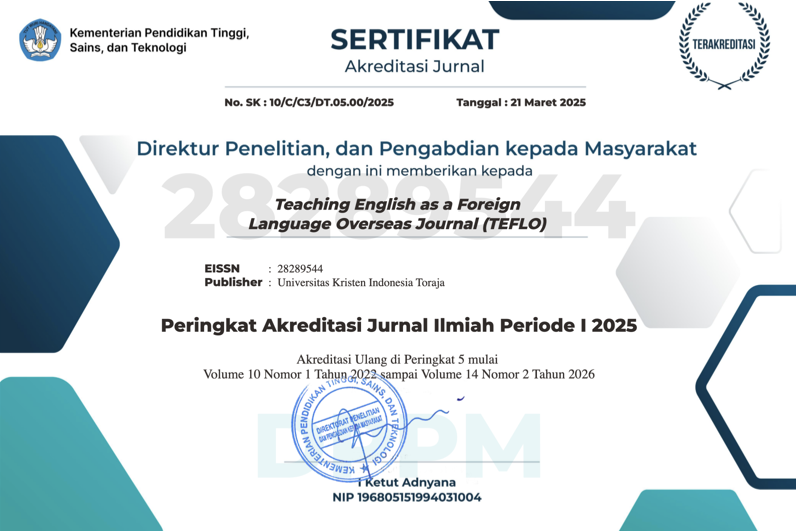
MOTIVATING THE FIRST YEAR STUDENTS OF SMP WAHYU MAKASSAR TO MASTER ENGLISH VOCABULARY USING QUESTIONS
DOI:
https://doi.org/10.47178/teflo.v10i1.1622Keywords:
Questions, Motivation, VocabularyAbstract
The purpose of this writing is to know the effect of using Questions in motivating students to master English vocabulary of SMP Wahyu Makassar. This research is experiment research that according to students ‘vocabulary knowledge. The population in this research is students’ class VII-A of SMP Wahyu Makassar with number of sample 25 students. This research holds on January 2016. In this research, the writer used test as the instrument that given on pre-test and post-test. The result of research showed that with using questions method in teaching and learning English process can improving students’ vocabulary of SMP Wahyu Makassar. In other words, with using questions can giving positive effect to students. Using questions in this research can be said success because can improving students’ vocabulary.
References
Ahmad. 2006. Productive Vocabulary Mastery and Speaking Ability for the Tenth Students of MA NW Pancor in the School Year 2006/2007. STIKIP Hamzanwadi Selong. Skripsi. Unpublished.
Cunningham, 1971. The Important of Questions in Learning English. New York : Mc Graw Hill Book Company.
Damaris. 2000. Improving the First Year Students of SLTP Negeri 8 Makassar to Master English Vocabulary Using Questions. Thesis. FBS Universitas Negeri Makassar. Unpublished.
Ellis & Sinclair, 1990. The strategies in Learning English Vocabulary. New York: Cambridge University Press.
Evriani. 2009. Improving the Second Year Students of SMPN 30 Makassar to Master English Vocabulary through Games Board. English Department Language and Arts. UNM Makassar. Skripsi. Unpublished.
Fraenkel. 1980. Important Key to Effective Learning. Los Angeles: University of California.
Hamsyah. 2006. Teaching Vocabulary through Games Technique Can Catch Student’s interest of SMPN
Makassar. English Department Language and Arts. UNM Makassar. Skrisi. Unpublished
Harmer, Jeremy. 2007. How to Teach English. England: Longmans
Hornby, AS.et. al. 1989. Oxford Advance Learners’ Dictionary of current Eng- lish. New York : Oxford University Press.
James Coady and Deborah, 1997. How to Teach English With Fun Learning. Internet Tessol, http://w.w.w.Ehow. Com. Retrieved on Tuesday, 4 No- vember 2014.
Kamil & Hiebert. 2005. Teaching Vo- cabulary ELBS. New York : Oxford University Press
Kemmis, S. and Taggart, R. 2006. The Action Research Planner ( third edi- tion ). Victoria: Deakin University Press.
Kustaryo, Sukiro. 1985. Knowledge of Communicative Language. Yogya- karta : Pustaka Pelajar Offset.
Legget, Similarly. 1992. Learning English Vocabulary. New York : Graw Book Company.
Logman, 2009. Magezine Style Theme Mag Essentials. Article. http://www. Personalogman.com/teaching-tips/ Engage-Study- Motivate.html. Re- trieved on Thursday, 22 October 2014.
Riren. 2008. Improving Students’ Skill to Master English Vocabulary of SMPN 30 Makassar at First Year Student Class - B Using Picture. Thesis. Fac- ulty of Teacher Training and Educa- tion – YPUP Makassar. Unpulished.
Rita. 2003. The Importance of Vocabulary in Learning A Foreign Language to Senior High School at Class – 2 C Kolaka. Thesis. Faculty of Teacher Training and Education – YPUP Makassar. Unpublished